 Advocates seek Puerto Rican cockfights bannned
ISLA VERDE, Puerto Rico - With cockfighting about to lose its last bastion in
the United States, animal rights activists are training their sights on Puerto
Rico, a U.S. territory where the cock sport is both beloved tradition and big
business.
But Puerto Rico shows no signs of quiting: Cockfighting is so entrenched
that the territory‘s legislature recently approved a bill establishing it as a
"cultural right" of islanders.
At Club Gallistico outside San Juan, one of 103 licensed cockfighting pits in
the Caribbean territory, the shouts of bettors rose Saturday with each frenzied
lunge of two sinewy roosters pecking and kicking at each other with curved
plastic spurs until one was bloodied and near death.
But participants could soon feel pressure from organizations such as the People
for the Ethical Treatment of Animals, which considers cockfighting barbaric...
¿No te digo?
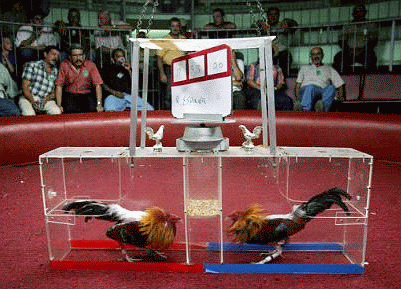
They look at each other once... y a pelear se ha dicho!
Puerto Rican aficionados, however, say activists and politicians cannot erase a
tradition dating from Spain‘s colonization of the Caribbean island more than
five centuries ago. Every other Puerto Rican is for "pelea de gallos." And
almost every town has a fighting pit or "gallera".
Cockfighting is so widespread in Puerto Rico that devotees feel no threat from
animal rights activists, unlike counterparts in Louisiana and New Mexico — the
only two U.S. states where the practice remains legal. Cockfighting has been
legal in Puerto Rico since 1933.
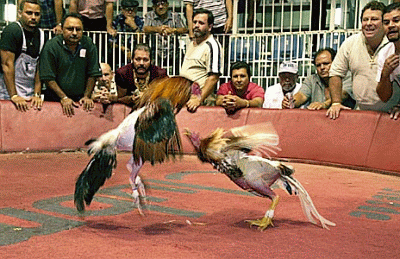
Each town has a few barrios, some two or three rings in
them.
Gamecock breeders, such as Rene Rodriguez, painstakingly train their feathered
fighters, injecting the birds with vitamins and sparring them to increase
endurance.
"Cockfighting in Puerto Rico is a gentleman's sport," Rodriguez said at his farm
in the central mountain town of Aibonito, where he breeds and trains the birds.
The best gamecocks are bred from prized bloodlines to ensure power, speed and a
brawling instinct and are pampered with the finest feed.
When fighting day arrives, the roosters are equipped with curved plastic spurs
(espuelas) attached to the back of their legs that serve to slash the opposing bird.
¡A tajo limpio!
Once
the birds are released into the pit, spectators crowd around and shout out the
stakes as they swap wads of money. The cocks circle as they look for advantage, neck feathers erect. They lunge at
each other and gouge, sometimes fighting to the death. The dead birds are
typically tossed into a barrel in a feathered heap.
Under Puerto Rican rules, a fight ends when a bird fails to get up or retreats.
If both roosters are standing after 15 minutes, it is a draw.
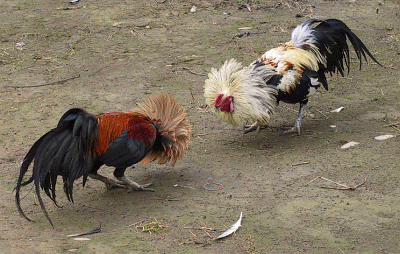
These birds need no ring... they see each other in the
backyard and
they engage in fight, with no provocation, no introduction and no motivation...
there has to be just only one in the roost.
Wayne Pacelle, chief of the Humane Society of the United States, said the group
plans to closely monitor the island‘s industry to ensure cockfighters are not
violating a new federal law that makes the transport of fighting birds or
cockfighting implements abroad or across state lines a felony. President Bush
signed the bill into law in May.
That's as far as they can reach... Ki-ki-ri-ki
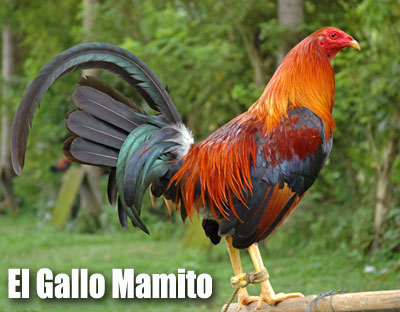
This guy here wants no trouble... all he wants is the
chicks! WEPA!

Peace and Prosperity,
Don Jíbaro "Whodatman" Barbanegra
~~~~~~~~~~~~~~~~~~~~~~~~~~~~~~~~~~~~~~~~~
"The wicked run when no one is chasing them,
but the honest are as brave as lions." —Proverbs 28:1
~~~~~~~~~~~~~~~~~~~~~~~~~~~~~~~~~~~~~~~~~

“Live in such a way that no one blames the rest of us
nor finds fault with our work.” --(2 Corinthians 6:3)

Jibaros.Com®,
Jibaros.Net® -
This website all its contents and artwork is Copyright © by
Orlando Vázquez, owner-designer. All rights reserved by the respective sources.
Derechos Reservados de los Autores. Jibaros.com does not accept
any responsibility for the privacy policy of content or services
provided by third party sites. - U.S. Copyright Office, 101
Independence Ave. S.E. Washington, D.C. 20559-6000.
HX-006699