Today is...

Les Rivera Interviews Don Jibaro

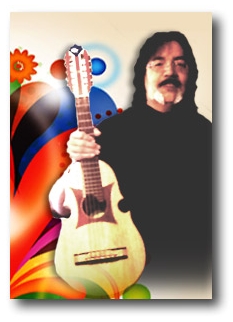 ne
of his quotes from jibaros.com reads: “A Puerto Rican shall not be
boring.” so, to describe Don Jibaro as anything less than riveting would be
an understatement of his own philosophy.
ne
of his quotes from jibaros.com reads: “A Puerto Rican shall not be
boring.” so, to describe Don Jibaro as anything less than riveting would be
an understatement of his own philosophy.
Don Jibaro is the owner/operator of some of the
world’s busiest Puerto Rican websites. Over
the years, Orlando (his real name) has also left a legacy of
volunteer work in the Los Angeles community. Among those, he
has co-founded a non-profit computer learning facility in
Los Angeles County. The instructors there
completed his certificate courses, and they in turn, are now
volunteering their skills to other people.
As a musician for 50 plus years, technician, teacher,
consultant, and web designer, Orlando stresses the importance of
education. He also helps people with creating a professional résumés to
help them land a job.
His additional community services include Spanish-English
translation services and that of an urban missionary, helping and
donating clothing, food and money to the homeless and poor of Los
Angeles area. Since 1977 he's also been an Evangelical Minister.
Here’s a
candid conversation we had at Starbucks Coffee, one of his favorite
places:
 Les Rivera: Orlando, on the World
Wide Web you are simply known as Don Jibaro. What is a “Jíbaro” and how
did the name Don Jíbaro evolve?
Les Rivera: Orlando, on the World
Wide Web you are simply known as Don Jibaro. What is a “Jíbaro” and how
did the name Don Jíbaro evolve?
 Don Jibaro: The noun “Don” is
actually a title, sort of “Mr.” or “Señor”, that implies importance. Its
etymology is Spanish, from the Latin “dominus”, master, dating back to
the 1500’s when Spanish noblemen and gentlemen used it as a title
prefixed to their Christian names, like Don Juan, Don Pedro, etcétera.
Don Jibaro: The noun “Don” is
actually a title, sort of “Mr.” or “Señor”, that implies importance. Its
etymology is Spanish, from the Latin “dominus”, master, dating back to
the 1500’s when Spanish noblemen and gentlemen used it as a title
prefixed to their Christian names, like Don Juan, Don Pedro, etcétera.
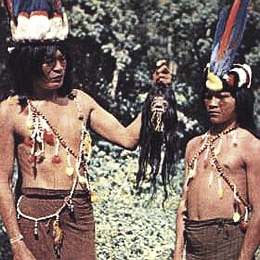
Jíbaro” is a misspelling that stuck of the word “jívaro”. Please
don’t be surprised as to the origin, because it’s a kind of dark one.
Although there were many headhunting cultures throughout the world, only
one group was known for the ancient practices, called tsantsa, of
shrinking human heads. They were called the jívaros, who lived deep in
the Ecuadorian and neighboring Peruvian Amazon.
The Jívaros migrated to the Caribbean and Puerto Rico in the
pre-Columbian times. When the Indians in Puerto Rico where annihilated
in the early 1600’s, the name “jíbaro” remained as a moniker for those
who chose the countryside and the mountains as their dwelling place.
Today, the name identifies the peasant or farmer, who works in the Puerto
Rican fields.
LR: What are your websites about and
why are they so popular among visitors from all over the world?
DJ: The websites are popular because
they give people something for free. I have a lot of
information, with good stories, and some of my writing is funny.
I designed it simple, so that it catches the eye. That is one of
my techniques for retention, and yet it’s a professional design
in the sense of the format. It’s easy to navigate...you link,
you go, and you come back.
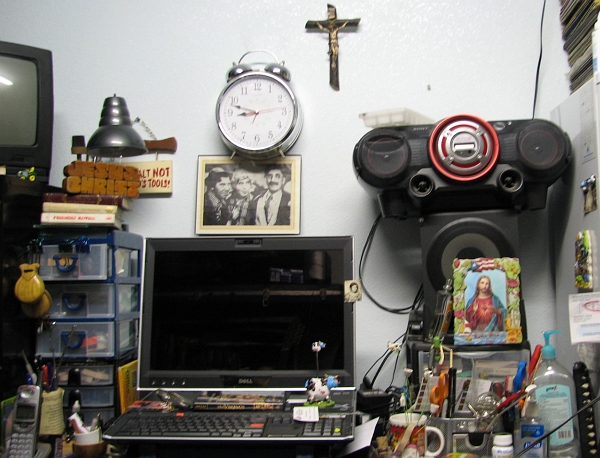
Don Jíbaro's desk... the 21"
laptop has been his workhorse for many years.
It also touches into things that Puerto Ricans want to know,
especially the Puerto Ricans in the United States, whose
language is primarily English and are away from their
homeland. It brings them a service to remind them of their
roots, the barrio, and the old days…the days of their parents
and grandparents. It’s a memory that anybody will cherish and
appreciate... and thus they keep coming back. I also try to bring in new stuff every
once in a while or so, and that keep
the people coming back.

I've always wanted to be a super hero with my
own slogan! "¡NO JODAH, CHICO!"
My fans, my readership, are the soul of my work, so I have
them in mind, rather than me saying… "I am great, dig me,
and love me." I also answer e-mails. I get a few hundred
e-mails a day and I try to answer lots of them… especially
those that are asking me for something that I can give,
because they are the fans. You cannot ignore that.
Basically, the website is about Puerto Rican culture and
then some; the soul of the Puerto Rican… it’s not about
Puerto Rico per se, because there is already a lot stuff about
Puerto Rico. But JIBAROS is more about the people and the
essence of their roots, the Educated Jíbaro.
LR: You have been a musician for more than 50 years.
What instruments do you play?
DJ: I started in 1963 with the drums and congas. I
played the drums for a couple of years… then I switched to
guitar, then bass for 20 years, and of course Latin
percussion: bongo, sticks and cowbells, etc. Most Puerto
Ricans play those instruments (laughter). I also took piano
in college, just to get a good understanding of music. It’s
good to have a piano foundation. In that way you’ll know the
rules of music. For the past 50 years, I have focused
mostly on the guitar and recently the cuatro.
LR: In the 1960’s to the 1970’s you were a full-time
musician, performing with bands in Puerto Rico, St. Thomas,
the Dominican Republic, and from Florida to Canada. After
years on the road as an artist, you ended up in Southern
California in 1976. Why did you settle in Los Angeles?
DJ: From 1969 to 1971, right up around when Jimi
Hendrix died, Puerto Rico went through a dry spell of
tourism. I was playing with a band in the Condado area,
right across the street from La Concha Hotel…this place
called the Playmate. We finished playing every night about 2
a.m. One night we left, and a couple of hours later, the
place blew up… somebody bombed up the joint! It turned out to
be some terrorist who blew up the place because he had an
anti-American sentiment. So, we’re out of work! After that
bombing things went from bad to worse. So I said, let’s
leave for the United States. I went with another band, and I
stayed in Boston for four and a half years.
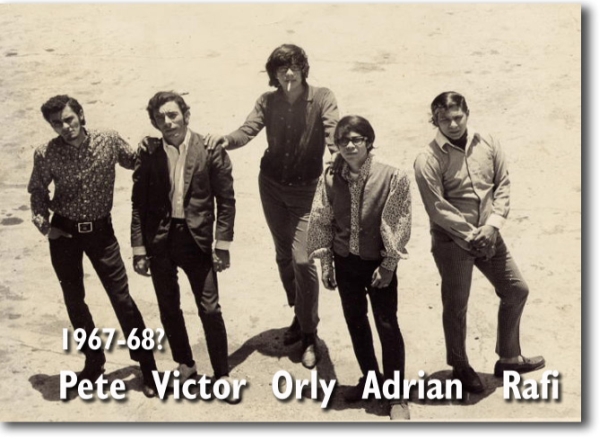
The
Telstars were the Kings of Miramar Center... we played the
lotsa (sic)
They were a fun group to be in, always happy and played
touch material, lotsa rhythm drive... Adrian has been
lifetime buddy of mine. I'm looking FWD to see him after 40
plus yrs
Before that I had
gone to the Virgin Islands and other nearby places. But in
Boston it was snowing four feet, and I was tired of the
snow. It was a real bad winter in ’76… real bad. I said,
man, that’s it! I decided to come to California.
I’d
heard about Sunset Boulevard and the Hollywood Hills, and
all the exotic stuff… so I threw a coin in the air, for L.A.
or San Francisco. L.A. won. So then I threw another coin in
the air, for L.A. or San Diego. L.A. won again! I packed up
all my stuff. I had three hundred dollars in my pocket, a
trunk full of books, a guitar, and a suitcase full of
clothing. Then I took a bus for seventy five
bucks, and I landed in downtown L.A… April 26, 1976!
LR: Nowadays you perform as a one-man band in different
places. What types of music do you present for your
audience?
DJ: My one man band is myself and a little computer,
called the Boss DR-5. I program the bass, drums, conga, piano and
percussion in it. Then I play it back through an amplifier
while I sing, playing the lead guitar... or cuatro. I sing
Latin jazz, old boleros, fifties romantic music, Puerto
Rican country music, some Hendrix or Beatles "latinized",
plus Puerto Rican salsa, in Spanish… a little bit in
English.
You can download the song Don Jíbaro's playing here "Seis"
(Six)
http://jibaros.com/mp3/seis.mp3
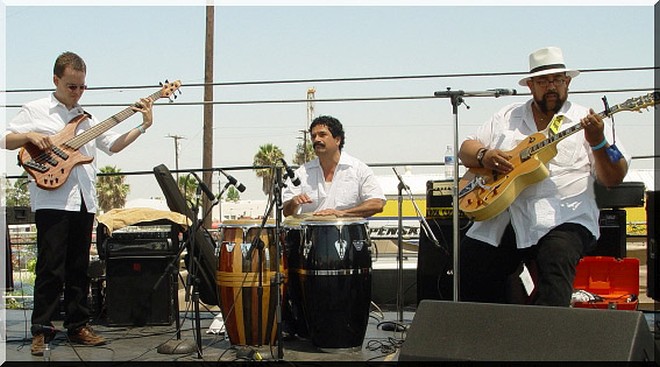
Don Jibaro's Trio at a 2004
Puerto Rican Festival in Los Angeles
You can also download the song Don Jíbaro's playing here "El Guapo"
(The Tough Guy) http://jibaros.com/mp3/guapo.mp3
I can charge two to three
hundred dollars for an hour or two and I don’t have to pay a
band. Everybody will show up for the gig. It sounds like a full
band, and it sounds professional. I cannot fire anybody, and
nobody can fire me. (laughter). It’s a great gig. I do Puerto
Rican coffee houses and restaurants, weddings, backyard parties,
mini festivals and stuff like that.
LR: Your musical preferences are quite varied, with a
personal taste for Beethoven to Tribal Tech to Gospel.
You mention Tito Puente and Eddie Palmieri as two
favorites. Did you ever get into the salsa craze when it
first began in the early 1970’s?
DJ: In the sixties Puerto Rico had two kinds of
people. The salseros… they were called “conservas”, and the
“roqueros”, that were us. We had long hair, wanted to speak
English, play rock ‘n roll. There were only a few of us. I
was one of the very few with shoulder lenght hair. Everybody
else was a “conserva”, you know, lots of starch in their
shirts. Their pants were ironed with a crease that could cut
mud! (laughter). You know, grease in your hair like you
would not believe! Whereas we hippies had jeans, tye dye
t-shirts, sandals, you know… a little scruffy looking.
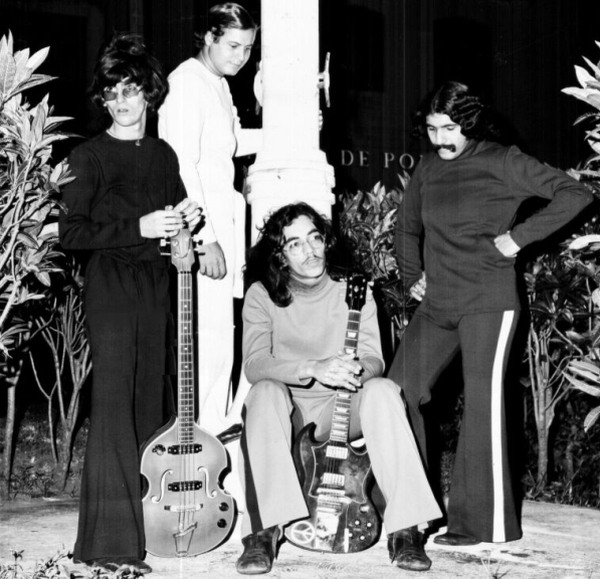
GRUPO LIFE: The salseros were called “conservas”, and the “roqueros”,
that were us. We had long hair, spoke English and played
rock ‘n roll.
But while I was into rock ‘n roll, I knew about salsa, which
would be something I’d play in the background. Then, when
this “American illusion” had wore out, I said, “no matter
where I am, I am Puerto Rican.” I mean, I am an American
citizen, but knew that I never was going to be which I was
try to become... a white guy. So, I said, let me embrace my
roots, let me embrace who I am, and I started getting into
salsa, jibaro, etc. although I still rock out occasionally.
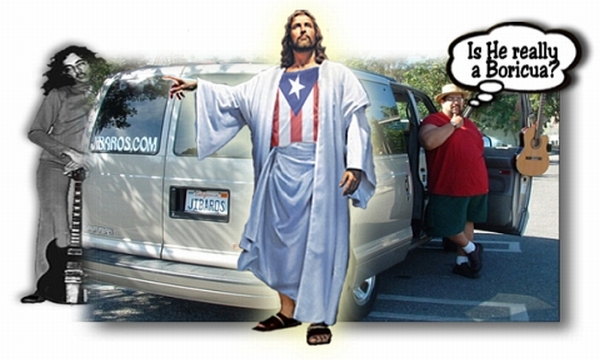
DJ takes his van to the park where he talks
to the Lord and croons to the squirrels...
It’s strange to think
that Ray Barretto saw me play in Puerto Rico, and he
produced one of my first records, which never got out. After
the record was done the band broke up. It was a great loss
for the Ray Barretto people. I still have the record… it was
a Latin rock ‘n roll/Latin jazz record, much before Santana
was big! The band broke up and that was the end of the
project.
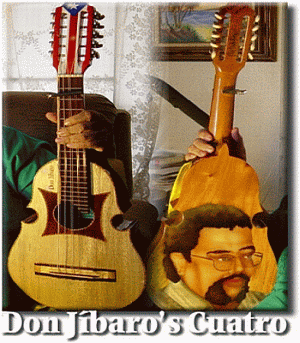
One among 6, this is the workhorse!
Years later I met Eddie Palmieri. He gave me a copy of his
record and I gave him a copy of my record. He autographed his
record for me, but I did not autograph mine for him, because I
am a musical “padawan” compared to him. That’s what brought me
into salsa. If the salsa is not exotic and highly syncopated, I
don’t like it.
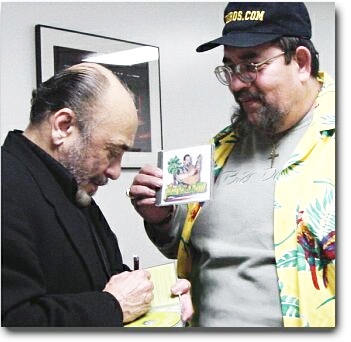
Eddie Palmieri signs his
"Obra Maestra" for Don Jíbaro while DJ
delivers his "Flight of the Chicken Hawk"
home made CD!
 Then you have Tito Puente (Concord years) with
his six harmony horn section.
That’s not easy salsa… that’s
major college degree salsa inflection! Did you check out Puente
and Palmieri’s “Obra Maestra” ? It’s their only album together
just before Puente died! I hear it in my head...and it’s Dizzy
Gillespie, Duke Ellington… with the heavy congas and bongos!
Brother, ayyy, it’s like a mamita on lace!!! (laughter).
Then you have Tito Puente (Concord years) with
his six harmony horn section.
That’s not easy salsa… that’s
major college degree salsa inflection! Did you check out Puente
and Palmieri’s “Obra Maestra” ? It’s their only album together
just before Puente died! I hear it in my head...and it’s Dizzy
Gillespie, Duke Ellington… with the heavy congas and bongos!
Brother, ayyy, it’s like a mamita on lace!!! (laughter).

"It is better to live in a corner of the roof, than
with a nagging spouse in a palace." —Prov.21:9



donjibaro@gmail.com

“Live in such a way that no one blames the rest of us
nor finds fault with our work.” —(2 Corinthians 6:3)

Jibaros.Com®,
Jibaros.Net® - ALL content is Copyright © by Orlando Vázquez,
owner-designer and com does not accept any responsibility for the
privacy policy of third party sites